·
3 min read
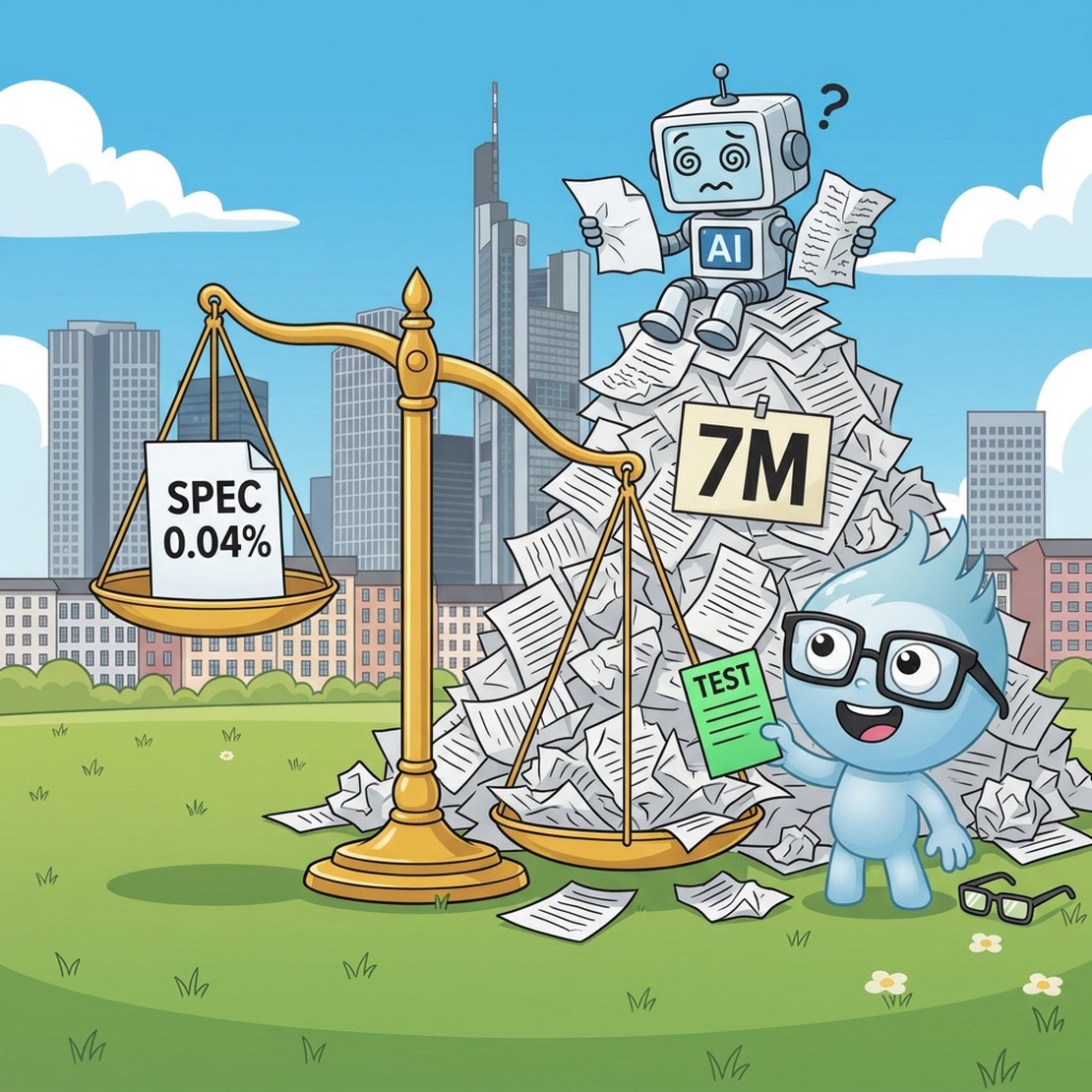
The spec is 0.04 percent. The misunderstanding is 7 million tokens.
Thursday afternoon, a review of our spec pipeline. The question on the table: use cases, acceptance criteria and …
Read More →Have questions? We're here to help.

Last week, Johann-Peter Hartmann reported on AI Dark Factory Patterns — a post I warmly recommend, including brutally honest anti-patterns. This is the current status quo.
“Dompteur” — animal tamer, wrangler — that would be me. But I’m changing. Last weekend: an experiment — library, CLI, 9 use cases, tests, 5-platform release. The agents autonomously implemented 16 features overnight while I slept. Maybe I’m slowly becoming the mechanic after all?
How this can work — agents writing and shipping code without a human ever seeing the code: Dan Shapiro on autonomous code shipping .
Dan Shapiro has developed a maturity model with 5 levels — from “AI writes code, human reviews” to the fully autonomous factory. The technology is here. It works.
But: what slowed me down wasn’t the agents. It was the vendor API. I was developing against the public API of a German software vendor — at least 500,000 customers in Germany. The result: undocumented deviations, endpoints that don’t exist. PDFs returned Base64-encoded instead of as files. An OpenAPI spec? Doesn’t exist.
And this is not an isolated case. Creating clients: manual. Generating reports: manual. Industry solutions? Data silos with no API. In 2026.
Here is the real problem:
| Level | Status |
|---|---|
| Level 0: Paper & Excel | ← many SMEs are here |
| Level 1: Digitalization | ← “we now have software” |
| Level 2: Standardization | ← most don’t make it here |
| Level 3: Integration | ← interfaces that don’t exist |
| Level 4: Automation | ← actively blocked |
| Level 5: Dark Factory | ← what we’re actually talking about |
Vendors are selling “AI features” in their products. At the same time, they build APIs as a one-way street: data in — easy. Data out — difficult to impossible.
On one side, autonomous code factories are on the horizon — you could integrate, combine, automate at unprecedented speed and quality. But established vendors aren’t playing along yet. Open APIs, complete documentation, bidirectional interfaces in the SME market? Nowhere to be found.
Operations follows Development follows Marketing:
Marketing: “We have AI!” →
Development: builds a chatbot into the app →
Operations: someone keeps typing reference numbers or addresses.
What needs to change:
The Dark Factory is technically possible.
The agents are ready. The vendors are not.
Thursday afternoon, a review of our spec pipeline. The question on the table: use cases, acceptance criteria and …
Read More →
Sunday at the Agentic Conf 2026 in Hamburg – and a feeling I hadn’t had in a long time. No vendor stage, no …
Read More →
Reviewing a Rust codebase, I was reminded what makes that language special: the compiler refuses. A forgotten error …
Read More →