·
2 min read
Operations follows Development follows Marketing
Last week, Johann-Peter Hartmann reported on AI Dark Factory Patterns — a post I warmly recommend, including brutally …
Read More →Have questions? We're here to help.
Any tool can automate dependency updates. Deciding which update brings security and which is just noise: that's the hard half. Our approach: detect daily, let an agent judge, apply weekly through the gates.
Most software today is mostly other people’s building blocks. They age: vulnerabilities become known, bugs get fixed, versions move on. Don’t update, and you accumulate risk. Update everything, and you accumulate work. And new risk.
The usual tools, Renovate or Dependabot, solve one half: they reliably detect what could be updated. What they can’t do is judge. Does this update carry a security fix that affects us? A bug fix in a part we actually use? Or just reformatted docs and a new logo?
That’s exactly where we now put an AI agent, with tight guardrails.
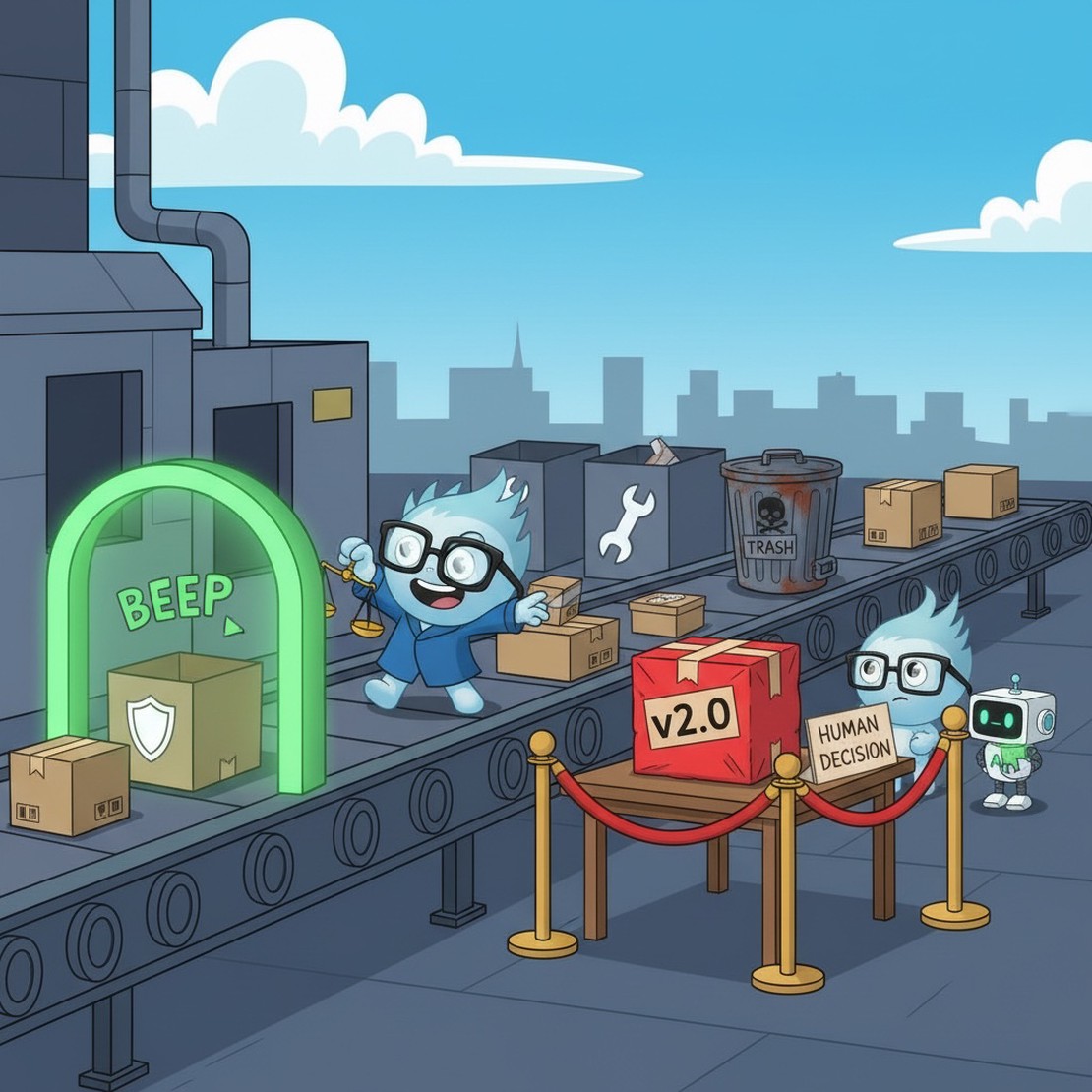
Detection runs daily. The agent reads the release notes and checks how we actually use the component. Then it sorts: security, stability, useful improvement, or noise. Noise is skipped, but visibly logged. Once a week, whatever survived the judgment gets applied. Through the same tests and checks as any other change.
Two rules proved themselves immediately:
First: “security” only counts with evidence from the official vulnerability databases. Release notes are marketing. A vendor writing “important security update!” doesn’t get the fast lane for it.
Second: major version jumps are always decided by a human. Even when the security fix exists only in the big jump. Especially then. That promptly happened to us for real: vulnerability confirmed, fix only in the new major version. The case lands on the table as an urgent proposal, not automatically in the release.
An update is a decision. Automate the decision, not just the click.
The tools have detected reliably for years. Judging used to take a human. That’s changing now. As long as the human writes the rules.
Last week, Johann-Peter Hartmann reported on AI Dark Factory Patterns — a post I warmly recommend, including brutally …
Read More →
Thursday afternoon, a review of our spec pipeline. The question on the table: use cases, acceptance criteria and …
Read More →
Sunday at the Agentic Conf 2026 in Hamburg – and a feeling I hadn’t had in a long time. No vendor stage, no …
Read More →